Biosite Blog Post Gabriella Lasserre
Going into biosite, I was unsure of what to expect. I had never done training to teach other students like it before. When I came to the first meeting, we had a fun activity where we analyzed different parts of trees and nature specimen. It was really interesting to learn that a lot of the things we were observing, even the little things, all contributed to our environment in the main picture of things. This was really eye-opening to know some of the harmful things that are endangering our environment and wildlife. Human activity plays a big role in that, and our environment would be so much cleaner if we took the steps to actually nurture out plants and animals. Little things like recycling, picking up after eating, and not leaving the faucet on all help so much in keeping the environment healthy and tidy. I got to understand this by working with my group on teaching the students about watersheds. My group was Vivian and Jessica, and I absolutely enjoyed being able to have this teaching experience with them. They were really collaborative and great with keeping the students intrigued and related to them and what they were learning often in the lessons. The groups of kids we taught were all very respectful and cooperative, which my group and I really appreciated as teachers. They asked questions and let us know if they weren't quite grasping a certain concept in the lesson. It was important that they communicated things like this to us so we could give them a more informative and memorable instruction. My favorite part of the watershed lesson was when we sprayed the model watersheds we drew and watched the runoff water mix with the marker on the paper. The kids got really excited and were laughing and having fun with us. If I had the opportunity to teach more kids in biosite again, I would love to take up the offer. Not only did I learn valuable teaching skills, but I also learned how to communicate in ways that different types of learners would understand. In addition, I acquired knowledge in how we can keep the environment we are in safe and in exceptional shape. Overall, biosite taught me valuable things about nature and the science of it around me and how to communicate about it to others, no matter the age of the audience.
Thursday, May 31, 2018

Wednesday, April 25, 2018
Blog Post #8
Blog Post #8
We've noticed that the leaves' phenotype in the Brassica oleracea plants has a big variation. In color and shape. Some are round and others have a squiggly form. Some look fern green and others look like emerald green. The round ones are shaped like an oval. Nice and smooth, and they consist of one color more or so. While the other leaves are pointy and squiggly with a purple outside.
During our further examination, we found that the Leaves have the same size despite all of the different features. This might of happened by the plants knowing what the perfect size to release CO2 and form into something else when ready. For instance, the average of all the leaves on the collards are 8 cm wide and 10 cm long, the Broccoli is 7.5 cm wide and 11 cm long, and on the cabbage are 9 cm wide and 9 cm long.
If a farmer wanted to change the size of the leaves you would have to plant it in a different way, like not in the same ecosystem or water it differently. This also can be genetically engineered to come out different but you may make a different plant when doing so. There is so much natural variations in these plants because we have domesticated them. By doing that, we changed the ecosystem that they grow in and changed how they got water and everything. That is called artificial selection. The mutations help the plants be more filling when we eat them. We use selective breeding to choose which traits we want to keep and which ones we don't. Meaning that we tend to pic the thicker ones than the dry scrawny ones.
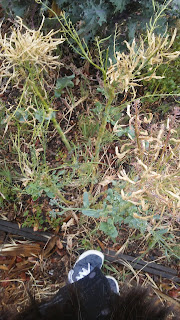
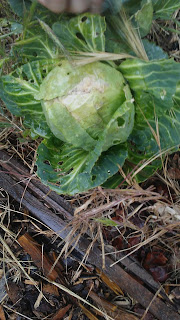
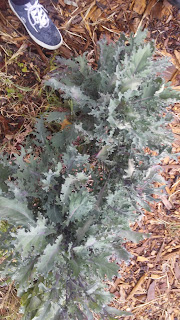

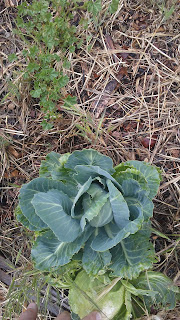

If a farmer wanted to change the size of the leaves you would have to plant it in a different way, like not in the same ecosystem or water it differently. This also can be genetically engineered to come out different but you may make a different plant when doing so. There is so much natural variations in these plants because we have domesticated them. By doing that, we changed the ecosystem that they grow in and changed how they got water and everything. That is called artificial selection. The mutations help the plants be more filling when we eat them. We use selective breeding to choose which traits we want to keep and which ones we don't. Meaning that we tend to pic the thicker ones than the dry scrawny ones.


Friday, April 20, 2018
Blog Post 8
Blog Post 8: A Matter of Selection by Gabriella Lasserre
We analyzed many different brassica oleracea in the garden when we were doing the story of the seed projects. I noticed that the anatomy of the plants that had the most variation was probably the leaves. They diversitized in the shape of the leaves. Some were shorter and fatter, while others were long, slim, and lanky. Some of the leaves even measured a few inches longer than others. Most of the leaves didn't have a very smooth and clean-cut look to them. They seemed quite jagged and bumpy to the touch.
I think the cause of all the genetic variability in the plants happens for a few reasons. the gene pool is randomly sorted to give genes just out of chance to the plants. There is also the allele frequency. which is also by chance. You really don't know where or when a gene will show up in a certain plant, and whether or not it could possibly result as a genetic mutation.
After taking measurements of the plants in our garden, we discovered that the brussell sprouts were 3 feet tall, the kohlrabi was 1 ft. 2 in. tall, the cauliflower was 11 in. tall, the kale was 2 ft. 7 in. tall, the cabbage was 10 in. tall, and our brassica oleracea, the tallest in the planter box at 3 ft. 1 in. I think some of the reason why some plants grew taller and bigger than others was the fact that they were engaging in competition, competing for things like nutrients, food, water, sunlight, ect. Some of the plants just naturally had larger buds on them and were predicted to take up a larger space as the normally do.
I think the leaves were very consistent in staying the same for all of the plants in the garden. When we analyzed them, a lot of them stayed really healthy and hydrated throughout the year, and the plants that didn't survive just had their leaves all died out and brown in the end.
I think plant breeders would ave to mix very vast leaves of different plants together because they are all very similar in the sense of how they look and feel, and even taste. Breeders would definitely have to experiment with different types of plants and analyze the gene pools to see which plants had what alleles so they could randomize to result in a different looking plant, or possibly even a new species.
Being able to see our plants mature throughout the seasons and see their growth was a really cool experience. I think students will really like the idea of being able to care for and study these interesting plants in the years to come. We got to understand the environment they lived in more and factors that helped out the plants and ones that didn't so much.
Monday, March 5, 2018
Flower Dissections
Angiosperms have to go through the procedure of pollination before being able to do any type of reproducing. Pollination happens with the male sex organs of the flower, on the anther which is connected to the end of the stamen. The pollen is then moved to the female sex organs of the plant. Pollen is transported by birds and insects like bees when they get the get what they need out of the flower. Wind is also a factor in pollination. So, the pollen will get to the pistil in the female sex organs, and will end at the stigma at the end of the pistil. The stigma then moves the pollen down a tube which is called the style which no goes down to the ovary. Angiosperms contain both female and male sex organs on the same plant, so the same flower does not need anything else to undergo the process of sexual reproduction.
These images are the sections of the broccoli plant taken apart and was examined under a microscope. You are able to see where the organs are of the flower.


These images are the sections of the broccoli plant taken apart and was examined under a microscope. You are able to see where the organs are of the flower.


Fertilization #7

This is a close up view of the petals of the flower. They are often brightly colored to attract pollinators to them so that the plant can reproduce.

This is a picture of the anthers of the flower. This is the top part of the male reproductive organ, called the stamen. The anthers are where pollen is stored.

This is a close up of the female reproductive organ of the plant, called the carpel. The tip of the carpel is sticky to catch pollen. It is called the stigma. The stigma is connected to the ovary with a tube called a style.

This is a picture of the ovary with ovules coming out of it. The ovules are what becomes a seed after fertilization takes place.
Flower #7
Angiosperms have to go through the procedure of pollination before being able to do any type of reproducing. Pollination happens with the male sex organs of the flower, on the anther which is connected to the end of the stamen. The pollen is then moved to the female sex organs of the plant. Pollen is transported by birds and insects like bees when they get the get what they need out of the flower. Wind is also a factor in pollination. So, the pollen will get to the pistil in the female sex organs, and will end at the stigma at the end of the pistil. The stigma then moves the pollen down a tube which is called the style which no goes down to the ovary. Angiosperms contain both female and male sex organs on the same plant, so the same flower does not need anything else to undergo the process of sexual reproduction.
These images are the sections of the broccoli plant taken apart and was examined under a microscope. You are able to see where the organs are of the flower.
These images are the sections of the broccoli plant taken apart and was examined under a microscope. You are able to see where the organs are of the flower.
Friday, March 2, 2018
Blog Post 7
Angiosperms first have to go through the process of pollination before being able to reproduce. Pollination occurs on the male sex organs of the flower, on the anther which is on the end of the stamen. The pollen is then transferred to the female sex organs of the flower. Pollen is typically transported by birds and insects like bees when they get the nectar out of the flower. Wind is also a helping factor in pollination. So, the pollen will arrive at the pistil in the female sex organs, and will be left at the stigma at the end of the pistil. The stigma then takes the pollen down a tube called the style which goes down to the ovary. Angiosperms contain both female and male sex organs on the same flower, so the same flower does not need anything else to undergo the process of sexual reproduction.
These images are the parts of the broccoli flower taken apart and examined closely under a microscope. You are able to tell where the sex organs are of the flower when viewed in the microscopic lens.
 | ||
This is the carpel of the flower. The carpel is where everything going on in the female reproductive system of a flower occurs. The carpel contains the stigma, style, ovary, and ovule, which basically means the carpel is the female reproductive system of the flower.
|

 |
| This is a view of a petal of the flower examined under the microscope. The petals typically have peculiar shapes and are very colorful in hue in order to enthral pollinators. |
 |
| This is the ovary in the female reproductive system of the flower. If you look closely at the small bead-like little balls coming out of it, you will notice that these are the ovules. These develop into seeds upon fertilization. |
How Does Your Garden Grow?
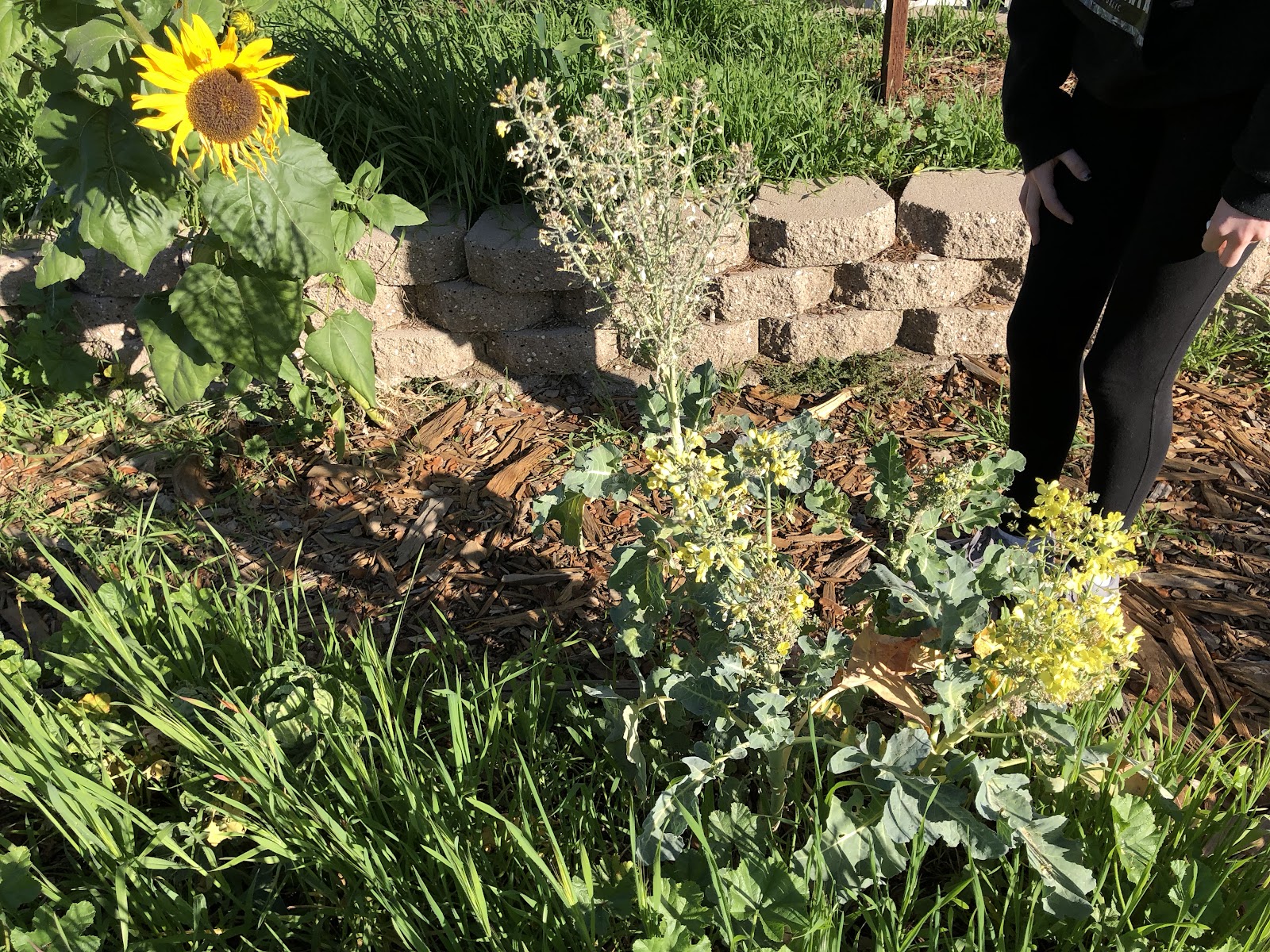
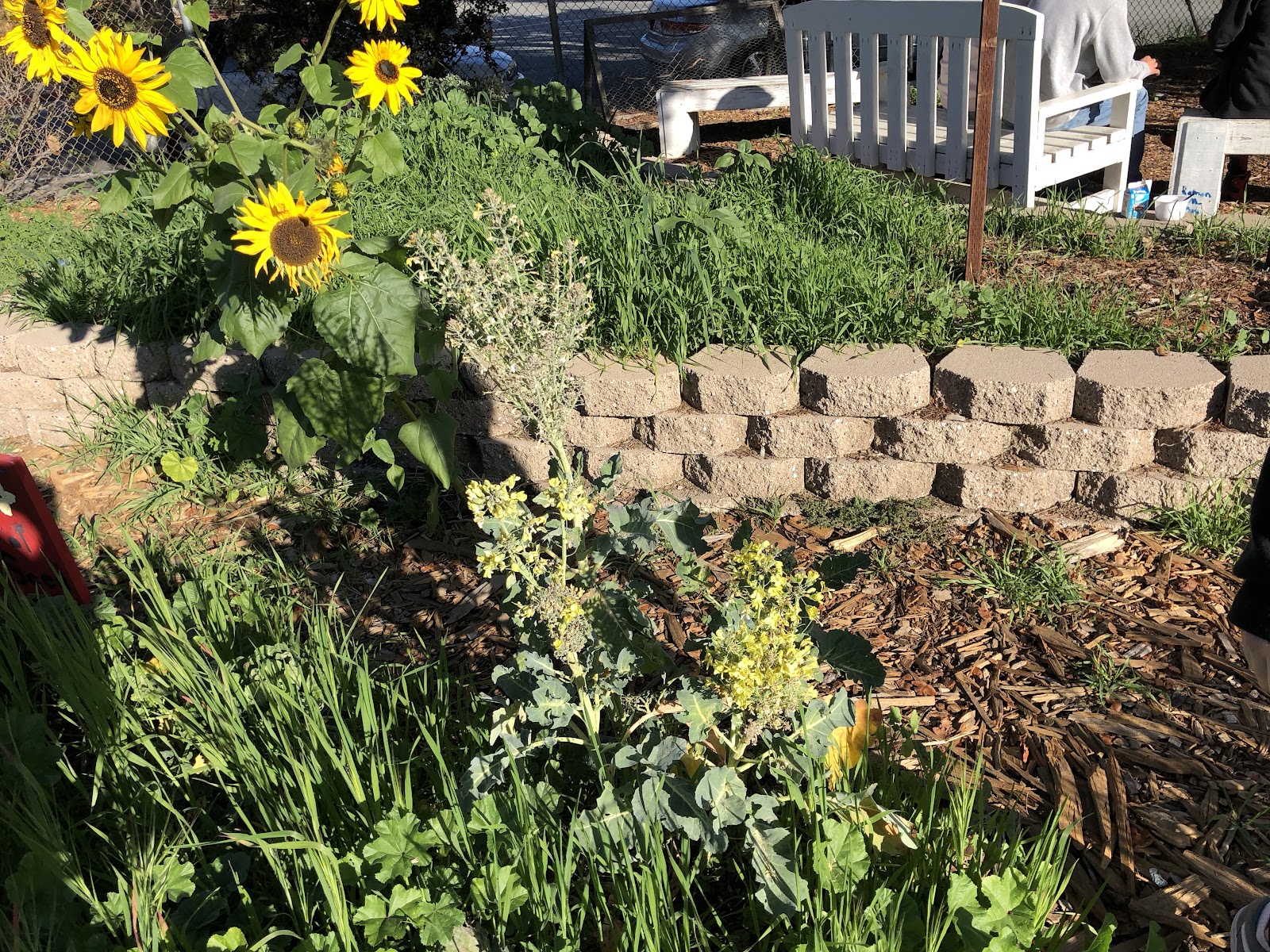
Our plant has grown a lot since we last saw it. Some of the plants even started flowering. There are many processes that go into our plants growing. The process by which biomass is added is called cell division. Cell division is how cells reproduce so that organisms can grow. Cell division starts off with interphase, which is when the cell performs its normal duties. Then, the cell starts to go into mitosis. The first step of mitosis, prophase, is when the chromosomes start to condense, spindle fibers emerge from the centrosomes, and the nuclear membrane breaks down. This step is the longest out of the process of mitosis. Next is metaphase. The chromosomes line up at the center of the cell and each sister chromatid is attached to a spindle fiber. In anaphase, sister chromatids are pulled apart and spindle fibers elongate the cell. Telophase is when the chromosomes reach opposite ends and the nuclear membrane starts to reform around them. Cytokinesis is when the two daughter cells split apart. Cell division happens the most on the tips of the roots of a plant because that’s where the plant is growing the most. Photosynthesis is how plants create their own food. Plants need sunlight, water, and carbon dioxide. There are two different cycles, one that requires light and one that doesn’t. Photosynthesis happens in the chloroplast of a plant. Photosynthesis produces oxygen and glucose, which can be used for cellular respiration. Cellular respiration uses oxygen to break down glucose into water and carbon dioxide. ATP captures the energy produced in this process. In eukaryotic cells like our plant’s cells, cellular respiration happens in the mitochondria of a cell. The mitochondria helps produce the power for a cell. All of these processes help the plant in different ways. Cell division helps the plant grow, photosynthesis allows the plant to have cellular respiration without consuming food, and cellular respiration creates energy for the cell.
If a cell needed to make more PKG or Rubisco, it sends a signal to the nucleus that it needs more. Both of theses are enzymes, which are a type of protein. Proteins are made of amino acid chains. In order to make these chains, DNA strands need to be transcripted into messenger RNA (mRNA) by RNA polymerase. Next, a ribosome reads the mRNA in sets of three, or codons, then translates it into amino acids. There are 64 possibilities for codons, including a start and stop codon. The amino acid chain then folds into an enzyme with a specific function.
If a cell needed to make more PKG or Rubisco, it sends a signal to the nucleus that it needs more. Both of theses are enzymes, which are a type of protein. Proteins are made of amino acid chains. In order to make these chains, DNA strands need to be transcripted into messenger RNA (mRNA) by RNA polymerase. Next, a ribosome reads the mRNA in sets of three, or codons, then translates it into amino acids. There are 64 possibilities for codons, including a start and stop codon. The amino acid chain then folds into an enzyme with a specific function.
Sunday, February 11, 2018
How does your garden grow! JT
Our Broccoli has gotten extremely larger from the last time we looked at it. It doesn't just put out more and more mass. So what exactly does it do? Well each of the cells go through mitosis. Mitosis is where a cell divides and creates basically a replica of itself. A cell first goes through interphase where the cell duplicates its organelles and copies its DNA. DNA is a pretty important thing in cells because it is what makes the plant different than any other plant. The DNA is copied through a semi-conservative replication. The process involves a couple enzymes and it occurs in the nucleus. The helicase unwinds the double helix and the DNA polymerase adds new nucleotides and copies the DNA. It is semi-conservative because one strand is copied backwards and the other one is copied normal. This is the longest phase by far. After interphase prophase happens. Prophase consists of the chromosomes condensing and the nucleus disappearing. Microtubles are also formed. Next, metaphase begins. In metaphase the chromosomes line up and prepare to be split. Then, anaphasae occurs and the chromosomes move to opposite sides of the cell. Finally telophase takes place. The chromosomes reach opposite walls and the cell begins to divide. Cytokenisis finishes it off and there is 2 new cells. Seems like a lot just for growth, but there are tons of cells constantly at work doing this and growing the plan or repairing it. For example, our plant has lots of holes from bugs eating it away and the holes will slowly form again because mitosis is happening. Also at the tips of the leaves the plant will be growing as well.
Enzymes are a crucial part of any living organism's life. Plants use a vast amount of enzymes, but where do they get them? If a cell is told a specific enzyme is needed, then it will begin protein synthesis, because enzymes are proteins. Protein synthesis occurs in the nucleus and ribosomes. Before anything happens the cell must create mRNA. This is made during transcription when a copy of the DNA is created. The mRNA has 3 letter sequences on it that are codons and they are codes for amino acids. After the mRNA is made it is sent to the ribosomes to begin translation. Translation is where the ribosome reads each codon using an anticodon and creates the correct amino acid. Once it is complete you are left with a new protein which if was asked for would be an enzyme.
Enzymes are a crucial part of any living organism's life. Plants use a vast amount of enzymes, but where do they get them? If a cell is told a specific enzyme is needed, then it will begin protein synthesis, because enzymes are proteins. Protein synthesis occurs in the nucleus and ribosomes. Before anything happens the cell must create mRNA. This is made during transcription when a copy of the DNA is created. The mRNA has 3 letter sequences on it that are codons and they are codes for amino acids. After the mRNA is made it is sent to the ribosomes to begin translation. Translation is where the ribosome reads each codon using an anticodon and creates the correct amino acid. Once it is complete you are left with a new protein which if was asked for would be an enzyme.
Friday, February 9, 2018
When I went out to the garden to check on my broccoli plant, the results were surprising. My team's broccoli plant had become the biggest plant in comparison to all the other team;s plants in the planter box. I looked even closer at the plant and took notice it was sprouting broccoli buds. They were pretty big, too when compared to the buds on everyone else's plant buds. I figure it will take some time for the broccoli buds to fully sprout, but if we keep an eye on them and make sure they are getting the resources they need, they will be fully grown soon enough.
I feel as though the broccoi plant may need to be moved to a arger planter box with more space in the near future however. It is starting to tower over the other plants. It may enagage in competition with the other plants for resources and make the other plants malnourished.
The rubisco enzyme catalyzes the carbon fixing step at the beginning of the Calvin cycle. This allows the plant to revive sunlight, water, and nutrients through photosynthesis. This also works with enzyme CEPC for the plant.
Overall, our plant has been thriving despite the competition and other limiting factors around it. I predict our plant will soon have full heads of broccoli ready to be harvested and tasted.
I feel as though the broccoi plant may need to be moved to a arger planter box with more space in the near future however. It is starting to tower over the other plants. It may enagage in competition with the other plants for resources and make the other plants malnourished.
The rubisco enzyme catalyzes the carbon fixing step at the beginning of the Calvin cycle. This allows the plant to revive sunlight, water, and nutrients through photosynthesis. This also works with enzyme CEPC for the plant.
Overall, our plant has been thriving despite the competition and other limiting factors around it. I predict our plant will soon have full heads of broccoli ready to be harvested and tasted.
Monday, December 18, 2017
Leah's Seed Story
1)What have you learned?
Leah learned how to care for a plant, the different types of reactions a plant goes through, how they are a major part of the world, and their interactions to the environment.
2)What's surprised you?
Leah was surprised on how fast her plant grew, and how they had holes in them because bugs were always eating them. Also, she was surprised by all that different cycles the plant was a part of.
3)What made you laugh?
What made her laugh was working with her team mates,i creating all the labs with their plants, and planting them and tending to them. Also, documenting and checking on their cabbage. The whole experience was fun and memorable.
4)What caused you to think a little deeper?
What made her think more was all the labs they did with their pants because before that she had no idea what went on inside of plants. All of the labs and lessons helped open my eyes to see how much plants go through and how they contribute a lot to the environment we live in.
5)Questions you have?
How did the chickens escape their coop? How did our plants grow so quickly?
Grace Slone's interview
Grace Slone’s story of the seed interview: blog post #5
By Gabriella Lasserre, P-1
For this blog post, I interviewed Grace Slone from our first period class. Upon asking her what she learned so far in this class this semester, she said she learned that competition doesn’t necessarily mean the consumption of one organism by another. The thing that surprised Grace was that in our first experiment, when we added chlorophyll to the mix the plant did not grow. What made Grace think deeper was how all organisms and chemical cycles are related and have an affect on one another. Something that made Grace laugh in the class was how everyone was lighthearted and kind, and always cracking jokes to lighten the mood. Overall, Grace had a good experience in the first semester of honors biology and learned many new things she didn’t know before.
\
Sam's Seed Story
What have you learned?
"I learned about the carbon cycle, water cycle, nitrogen cycle, competition between plants in the garden, and how seeds germinate."
What surprised or amazed you?
"I was surprised that plants can grow in a variety of different condition whether it's in competition, upside-down, or in limited space."
What made you laugh?
"I laughed when I found out how much grass we had to cut because I thought it was excessive."
What made you pause and think a little deeper?
"When my kohlrabi plant wasn't growing as fast or as much as the other plants I had to think what factors were affecting it."`
"I learned about the carbon cycle, water cycle, nitrogen cycle, competition between plants in the garden, and how seeds germinate."
What surprised or amazed you?
"I was surprised that plants can grow in a variety of different condition whether it's in competition, upside-down, or in limited space."
What made you laugh?
"I laughed when I found out how much grass we had to cut because I thought it was excessive."
What made you pause and think a little deeper?
"When my kohlrabi plant wasn't growing as fast or as much as the other plants I had to think what factors were affecting it."`
Thursday, December 14, 2017
Sydney's Seed Story
Sydney has learned many thing while doing her seed project like how plants need light, carbon dioxide, and water to grow correctly and that if you add more chlorophyll to your plant it will not grow. What made her laugh was naming her plants and messing around with her friends in this group. Some things that surprised her is that her plants took 5 days to sprout and that breaking the ends of the roots on there plants they still grew. While she was doing her project a few things made think deep like how long does plants take to fully grow up and how making plants work you need a constant supply of water and carbon dioxide.
Friday, December 1, 2017
Enzyme Lab Report
Group 1-1 Names
JT Wellman, Gabriella Lasserre, Katarina Myers, Lupe Castillo
Introduction:
In this lab, we decided to investigate the effect of environment factors on the enzyme hydrogen peroxidase. To do that we decided to test the substrate concentration and how it affects the enzyme’s productivity. For this we used ripgut brome grass(bromus diandrus), substrate and water.
Materials:
- Digital balance (scale)
- Mortar and pestle
- 3 100-liter glass or plastic beakers
- 1 mL or 5 mL syringe
- Hydrogen peroxide
- Glass test tubes
- Test tube rack or holder
- Safety glasses
Procedure:
1) Gather materials
2) Put on safety glasses
3) Set up your lab with materials.
4) Weigh the brome grass to make sure it is between 5 to 10 grams
5) Grind the grass with the mortar and pestle
6) Pour the solution into 5 test tubes
7)Then we pour different amounts of the hydrogen peroxide ( 10%, 20%, 40%, 50%, 80% ) in the test tubes
8) Measure and record the height of the reaction
9) Write data results and conclusion
Hypothesis
If the substrate concentration increases then the rate of enzymatic reactions will increase to a certain point then steady out.
Independent Variable: substrate concentration
Dependent Variable: peroxidase
Controlled Variables: temperature, pH, enzyme concentration
We chose this because when substrate concentration goes higher, it increases enzyme productivity because there are more substrates to work on.
Summary:
We are going to test how enzymes are affected when the controlled variable of substrate is added to the equation. We will be testing this by running 5 different experiments and placing varying amounts of hydrogen peroxide in each to see the result and record it.
Data and Results:
At 80% of substrate concentration with 5 ml of enzymes solution we found that we had 6 ml of peroxidase in 10 minutes. At 50% of substrate concentration with 5 ml of enzymes solution we found that we had 9 ml of peroxidase in 10 minutes. At 40% of substrate concentration with 5 ml of enzymes solution we found that we had 10 ml of peroxidase. At 20% substrate concentration with 5 ml of enzymes solution we found that we had 8 ml of peroxidase in 10 minutes. At 10% of substrate concentration with 5 ml of enzymes solution we found that we had 3.5 ml of peroxidase in 10 minutes.

Conclusions:
Many steps were taken in order for us to achieve our results for this lab. By the end of the lab, we analyzed the results and concluded that increasing substrate concentration increases enzyme productivity. However, at a certain point, the productivity decreases. As seen in our data, we got the most results of ml of peroxidase at 50% substrate concentration. 50% substrate concentration gave us 9ml of peroxidase.
Thursday, November 16, 2017
Ecoclogical analysis of the garden
What are some abiotic factors on which your plant depends for its survival? What about biotic factors that affect your plant? Describe some of these factors
Some abiotic factors our plant depended on to survive were soil, sunlight, water, temperature/climate. Some biotic factors are other plants competing for nutrients, sunlight, space, water, as well as other abiotic factors and also if the plants are receiving enough nutrients.
How do you know your plants are engaged in competition? For what are your plants competing, and who is the competition?
Yes, my plant is engaged in competition. I know this because the space in which it was planted was a tightly constructed planter box. It was also planted with many other plants, so they are all competing for the abiotic factors i stated above against the other plants with them.
How are "winners" and "losers" determined in this struggle? Is it always so clear cut who "wins" and who "loses?" What makes that determination complicated sometimes?
It is not always definite which plants lose or win, since some plants have a life cycle shorter than that of another plant in competition of them. Ususally the plants that are the healthiest and grow the tallest or widest are the "winners" of the competition. Those who look malnourished, shorter or smaller are are the "losers" of the competition.
Describe other types of interaction (besides competition) in which your plants are involved. Make sure to explain how this interaction affects each organism involved.
Some plant and animals both benefit from being with each other, which is mutualism. An example of that happening with the plants in our garden is the bees taking the pollen from the plants, so the plants can more easily produce pollen quicker. However, sometimes plants are harmed when working with another organism, because one organism is benefiting while the other is negatively affected. An example of this is aphids feeding on a plant. They are weakening the plant and take away the nutrients the plant needs to survive.
What evidence is there in the garden that succession (or something like it) is occurring in the garden ecosystem? Does it seem more like primary or secondary succession?
Succession can be noticed in an environment when new organisms grow on a land that had been previously housing other living plants that gt destroyed. Our plants are more secondary succession, because gardens had been planted where they are now previously and the plats had died or been transported somewhere else. It would not have been primary succession because that would mean that our plants started on fresh, brand new ground.
Monday, November 13, 2017
Analysis of garden JT
1. What are some abiotic factors on which your plant depends for its survival? What about biotic factors that affect your plant? Describe some of these factor
Factors our plant depends on are rocks, dirt, and sunlight and most important water. Some plants are better placed as others. Like so a desert but lucky for our plants they are in a rose bin but it sill has abiotic and biotic factors. Some biotic factors that affect our plant are others plants, insects and birds and the chicken, they are in there coop next to our project. our plants are always engaged in different types of interaction.
2. How do you know your plants are engaged in competition? For what are your plants competing, and who is the competition?
Our plant is almost always in competition. We know by Different plants in the garden have the same biological niche as ours, and their are limited resources in the garden. The plants are competing for many things, including water, sunlight, and space. Space is very limited in the rose box, so it is one of the resources that is most competed for. The limited space also has an affect amount of sunlight available to our plants, because taller, more spread out plants could block other plants from getting any sunlight.
3. How are "winners" and "losers" determined in this struggle? Is it always so clear cut who "wins" and who "loses?" What makes that determination complicated sometimes?
Almost all plants can be a winner or a loser. Winners can be determined by which plant grows fully for as long as it can. Losers would be smaller plants that can’t get the resources they need, and therefore die first. It is not always clear cut as to who wins and who loses. It can be complicated because some plants naturally die faster than others. Other plants don’t grow very big, but are still winning against much bigger plants.
4. Describe other types of interaction (besides competition) in which your plants are involved. Make sure to explain how this interaction affects each organism involved.
One other interaction is pollination from bees. This is mutualism because the bees help the plants reproduce by pollinating them, and the plants produce nectar for the bees to eat. Another example could be insects including wormss that feed off of the plants. This relationship would be parasitic.
5. What evidence is there in the garden that succession (or something like it) is occurring in the garden ecosystem? Does it seem more like primary or secondary succession?
the plants are adapting to the garden ecosystem and growing where there was a existing garden. It seems more like secondary succession because primary succession starts on freash/new land. Secondary succession happens when there was already a community that was destroyed, like in the garden.
Factors our plant depends on are rocks, dirt, and sunlight and most important water. Some plants are better placed as others. Like so a desert but lucky for our plants they are in a rose bin but it sill has abiotic and biotic factors. Some biotic factors that affect our plant are others plants, insects and birds and the chicken, they are in there coop next to our project. our plants are always engaged in different types of interaction.
2. How do you know your plants are engaged in competition? For what are your plants competing, and who is the competition?
Our plant is almost always in competition. We know by Different plants in the garden have the same biological niche as ours, and their are limited resources in the garden. The plants are competing for many things, including water, sunlight, and space. Space is very limited in the rose box, so it is one of the resources that is most competed for. The limited space also has an affect amount of sunlight available to our plants, because taller, more spread out plants could block other plants from getting any sunlight.
3. How are "winners" and "losers" determined in this struggle? Is it always so clear cut who "wins" and who "loses?" What makes that determination complicated sometimes?
Almost all plants can be a winner or a loser. Winners can be determined by which plant grows fully for as long as it can. Losers would be smaller plants that can’t get the resources they need, and therefore die first. It is not always clear cut as to who wins and who loses. It can be complicated because some plants naturally die faster than others. Other plants don’t grow very big, but are still winning against much bigger plants.
4. Describe other types of interaction (besides competition) in which your plants are involved. Make sure to explain how this interaction affects each organism involved.
One other interaction is pollination from bees. This is mutualism because the bees help the plants reproduce by pollinating them, and the plants produce nectar for the bees to eat. Another example could be insects including wormss that feed off of the plants. This relationship would be parasitic.
5. What evidence is there in the garden that succession (or something like it) is occurring in the garden ecosystem? Does it seem more like primary or secondary succession?
the plants are adapting to the garden ecosystem and growing where there was a existing garden. It seems more like secondary succession because primary succession starts on freash/new land. Secondary succession happens when there was already a community that was destroyed, like in the garden.
Biochemical cycles by JT
- What changes do you notice in your plants this week? Describe the overall appearance of your plant. Our plants very spread out leaves; 38 cm tall and is 34 cm wide, with the leaves having a sort of dark mint green color. What I also noticed was that we have the biggest and tallest plant in the garden, therefore it tells us that it is getting enough of water and sunshine. Something else we observed was that some of the leaves have been munched on by our neighboring pests. We don't think they will have any affect knowing that our plant is growing very well and healthy and it will find a way to regenerate.
2. How do your plants participate in the movement of water in the biosphere? How do your plants' roles in the water cycle relate to the changes you observed in your plants this week?Our plant has to absorbs the water, then it releases it back into the atmosphere from the small pores in the underside of it's leaves. It is called transpiration. This is letting the plant release the water it doesn't need so it doesn't drown or get too soggy if that's a thing. Also, it may be the reason why it's leaves aren't a bright green like most plants. The amount of water it releases is sufficient for the plant to stay healthy but not enough to give it that bright green other plants.
3.How do your plants participate in the movement of carbon in the biosphere? How do your plants' roles in the carbon cycle relate to the changes you observed in your plants this week? They do this process called photosynthesis. This is where they absorb the carbon dioxide from the atmosphere and mix it with water. Using the energy of the sun of course. During this process, they also make their own food, this is why we have the biggest plant because our plant is doing more of the photosynthesis
4.How do your plants participate in the movement of nitrogen in the biosphere? How do your plants' roles in the nitrogen cycle relate to the changes you observed in your plants this week? The bacteria from our plant forms into nitrogen in the soil into ammonia, this is called fixation. Then they go through the process of nitrification which lets the bacteria turn the ammonium into nitrates which the plants can absorb through their roots. Plants need certain minerals for healthy and one of them being nitrate. Nitrates help the plant make amino acids which are needed to make proteins.
Friday, November 3, 2017
Ecological Analysis of the Garden
- What are some abiotic factors on which your plant depends for its survival? What about biotic factors that affect your plant? Describe some of these factors
Some abiotic factors our plant depends on are soil, sunlight, and climate. Different plants are better suited for different climates because they need more water or cooler temperatures to survive. The amount of wind on a plant also has an affect on its growth, as shown in our initial experiment. Some biotic factors that affect our plant are others plants, insects and birds. They are engaged in different types of interaction.
- How do you know your plants are engaged in competition? For what are your plants competing, and who is the competition?
We know our plant is engaged in competition because other plants in the garden have the same biological niche as ours, and their are limited resources in the garden. The plants are competing for many things, including water, sunlight, and space. Space is very limited in the small garden box, so it is one of the resources that is most fiercely competed for. The limited space also has an affect amount of sunlight available to our plants, because taller, more spread out plants could block other plants from getting sunlight.
- How are "winners" and "losers" determined in this struggle? Is it always so clear cut who "wins" and who "loses?" What makes that determination complicated sometimes?
Winners can be determined by which plant grows fully for as long as it can. Losers would be smaller plants that can’t get the resources they need, and therefore die first. It is not always clear cut as to who wins and who loses. It can be complicated because some plants naturally die faster than others. Other plants don’t grow very big, but are still winning against much bigger plants.
- Describe other types of interaction (besides competition) in which your plants are involved. Make sure to explain how this interaction affects each organism involved.
Competition is just one of the different types of interaction that our plants are involved in. One other interaction is pollination from bees. This is mutualism because the bees help the plants reproduce by pollinating them, and the plants produce nectar for the bees to eat. Another example could be insects including aphids that feed off of the plants. This relationship would be parasitic.
- What evidence is there in the garden that succession (or something like it) is occurring in the garden ecosystem? Does it seem more like primary or secondary succession?
The evidence that succession could be occurring in the garden is that the plants are adapting to the garden ecosystem and growing where there was a previously existing garden. It seems more like secondary succession because primary succession starts on new land. Secondary succession happens when there was already a community that was destroyed, like in the garden.
- What changes do you notice in your plants this week? Describe the overall appearance of your plant. Our plant has grown very big and has very spread out leaves; 38 cm tall and is 34 cm wide, with the leaves having a sort of dark mint green color. What I also noticed was that we have the biggest and tallest plant in the garden, therefore it tells us that it is getting plenty of water and sunshine. Something else we observed was that some of the leaves have been munched on by our neighboring pests(insects). We don't think they will have any affect knowing that our plant is growing very well and healthy and it will find a way to regenerate.
2. How do your plants participate in the movement of water in the biosphere? How do your plants' roles in the water cycle relate to the changes you observed in your plants this week?Our plant absorbs the water, then releases it back into the atmosphere from the small pores in the underside of it's leaves. This is called transpiration. This is letting the plant release the water it doesn't need so it doesn't drown or get too soggy if that's a thing. Also, it may be the reason why it's leaves aren't a bright green like most plants. The amount of water it releases is sufficient for the plant to stay healthy but not enough to give it that bright green other plants.
3.How do your plants participate in the movement of carbon in the biosphere? How do your plants' roles in the carbon cycle relate to the changes you observed in your plants this week? Plants are pretty much the starting point of the carbon cycle. They do this process called photosynthesis. This is where they absorb the carbon dioxide from the atmosphere and mix it with water. Using the energy of the sun of course. During this process, they also make their own food, so I'm guessing that our plant is photosynthesizing exceptionally and that explains how it has grown so big.
4.How do your plants participate in the movement of nitrogen in the biosphere? How do your plants' roles in the nitrogen cycle relate to the changes you observed in your plants this week? The bacteria turns the nitrogen in the soil into ammonia, this is called fixation. Then they go through the process of nitrification which lets the bacteria turn the ammonium into nitrates which the plants can absorb through their roots. Plants need certain minerals for healthy and one of them being nitrate. Nitrates help the plant make amino acids which are needed to make proteins. This must mean that our plant has plenty of nitrogen in it's soil and enough bacteria to make these two processes which keeps it healthy and growing wonderfully.
Subscribe to:
Posts (Atom)